
Reflections from the Global Land Forum
Samuel Tabory, Global Research Lead, CoRe
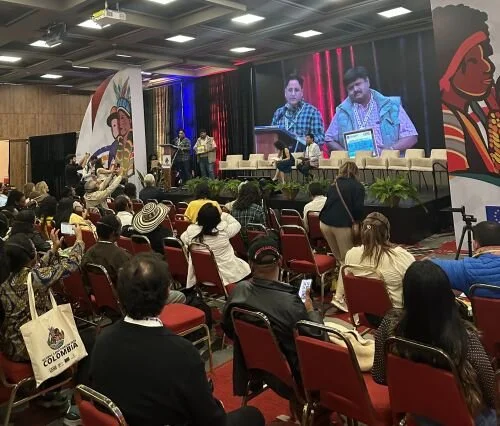
In mid-June, partners, members, and friends of the International Land Coalition met in Bogotá, Colombia for the 2025 Global Land Forum.
Across five days of intensive discussions and working sessions involving Indigenous people’s organizations, coalitions of smallholder family farmers, local civil society organizations, national and international NGOs, as well as national and international agencies, one theme kept coming up: keeping land on the agenda of governments and donors by making the case that it is at the center of interconnected climate, biodiversity, and livelihood goals.

Image Credit: International Land Coalition
This “Land Tenure+” framing, centering multi-dimensional impacts and the critical role that inclusive governance in the land sector plays in realizing those impacts, has been gaining momentum in policy and practice circles, not least due to the leadership and work of ILC members and partners.
Whether in reference to upcoming negotiations at the UNFCCC CoP 30 in Brazil later this year, or the ICARRD +20 forum to be held in Colombia early next year, the message seems to be clear: this isn’t land reform as usual. To be clear, the needs and priorities of smallholder and family farmers remain at the center of global calls for newly invigorated commitments to land reform. However, there is increasing awareness of the central role for equitable land governance in mitigating the intersecting “poly-crises” of our times.
In reflecting on this unifying message, and the ongoing work that ILC partners and members worldwide are doing to advance it, I left the forum particularly energized about two broad strands of CoRe’s work that, to us, embody critical paths forward in keeping equitable land and natural resource governance on national and international agendas.
From multi-stakeholder processes to IPLC-led networks for policy transformation
First, there is an opportunity to build on the decades of work of ILC members in the land sector to increasingly supplement direct land titling and tenure support. Specifically, this includes pushing further into a systems-oriented understanding of how to influence enabling environments that fundamentally shape how land is distributed, stewarded, and put to economic and cultural use, not least in food and agricultural systems. National and subnational multi-actor platforms (MAPs)—including those supported by ILC in the form of 35 National Land Coalitions, or those convened by ILC partners and members, such as WHH’s Land for Life program across sub-Saharan Africa—have proven to be an important starting point for broader reform efforts. But the gathering momentum behind goals of channeling more direct climate transitions funding to Indigenous Peoples and local communities (IPLCs) presents an opportunity to support further expansion of IPLC voice and agency in the articulation of networked, bottom-up, and IPLC-led policy transformation processes in the land and food sectors.
MAPs are an important space in which IPLC perspectives can and should continue to be represented, but increasing direct support to network- and coalition-building efforts of IPLC constituencies seeking to strategically align systems change efforts for policy transformation can be a powerful and alternative motor driving the development of innovative policy integration and reform agendas. Such agendas are in part so powerful because they are informed by locally grounded expertise and community realities. In an increasingly constrained international funding environment, relatively modest investments in networked coalitions for IPLC-led policy transformation hold the possibility of changing the fundamental conditions of upstream enabling environments that give shape to the on-the-ground governance of land, food, and natural resource sectors. Such a perspective sees and invests in IPLC constituencies as co-creators of policy and systems change, not simply as beneficiaries or implementors of national or international policy agendas.
Putting the land in the landscape approach
Second, while already embedded in the work of many ILC partners and members, greater emphasis within the land sector on the role of landscape and bio-regional approaches to land system governance represents a potentially powerful unifying frame for the grounded delivery of multi-dimensional impacts across climate, biodiversity, livelihood and food sovereignty agendas. For example, the Foundation for Ecological Security (FES), an ILC member and long-time partner of CoRe, has been working with landscape-scale MAPs to protect and restore the Commons in India for more than a decade. The FES model merges critical concern for community land access/rights, landscape level ecological system restoration/health, as well as increasing the voice and agency of women, tribal populations, and scheduled castes in context based planning processes. By working at the landscape-scale, and with the landscape approach, this model provides an effective vehicle for improving rural livelihoods and doing so in ways that put communities at the center of reforms. Landscapes as units offer a shared scale beyond an individual plot or community, while still being grounded in local realities, from which to diagnose existing conditions, to build shared visions of future landscape health and functioning, and ultimately to work toward realizing those visions.
The landscape-scale MAPs that FES convenes have demonstrated a track record of leveraging community level priorities and innovations to shape evolving policy and practice norms around land and natural resource management beyond their immediate context, influencing change at the district and state levels. It’s no surprise then that at this year’s Global Land Forum, FES was presented with the ILC “Global Challenge: Inequality” award for its innovative work championing inclusive landscape governance and protection of the Commons. As the landscape approach gains traction in both grounded practice and international policy agendas, in no small part thanks to the global efforts of organizations and initiatives like 1000 Landscapes for 1 Billion People, Regen10, or CommonLand, there is an opportunity to further link the learnings and strategies of the more traditional land reform sector and the emerging movement in support of landscape approaches to the protection and stewardship of both smallholder livelihoods and critical ecosystems.
Looking ahead
There are plenty of threads and linkages already at play across ILC members, partners, and friends regarding both of the above pathways. CoRe looks forward to continuing to be a part of these efforts, and even more so, to witnessing the experimentation and creativity that others may bring to their own work on such efforts. All will hopefully be contributing to the increasing body of knowledge about how to drive systems change for inclusive governance in the land and natural resource sectors.
As the fall climate policy dialogue season will soon be upon us, from New York Climate Week to COP 30, CoRe shares the ambition of many in the ILC family to keep land on the global agenda, to link it to multi-dimensional climate-nature-livelihood goals, and to do so in creative and innovative ways that amplify grounded community perspectives and expertise for systemic change.
You tell us!
What we’re reading
We’re constantly gathering key insights that inform our work. From academic research to partner perspectives, these are the pieces shaping our thinking right now.


En español: